

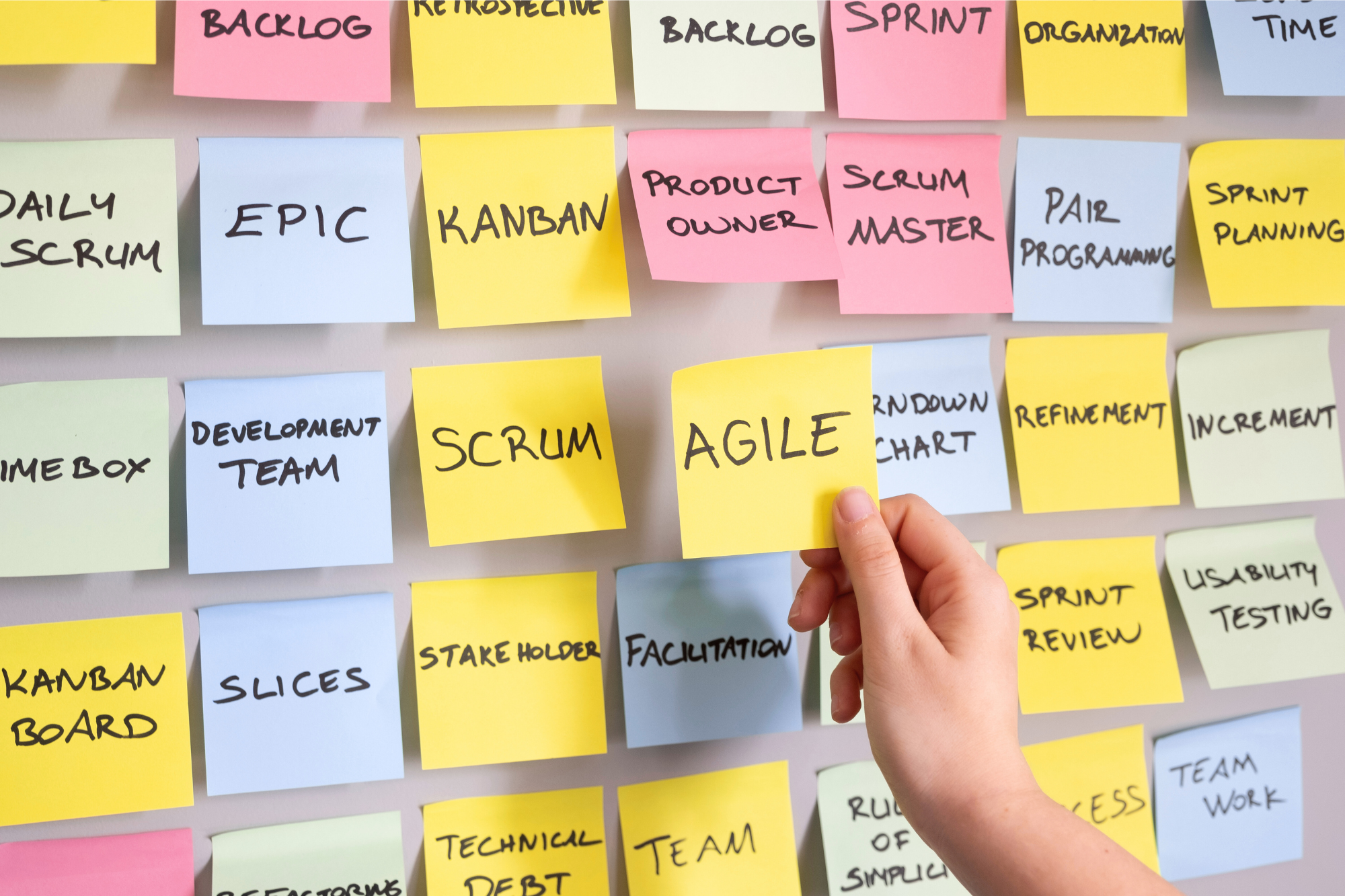
In today’s rapidly evolving business landscape, traditional project management models are increasingly giving way to flexible and adaptive approaches. Plans created months in advance quickly become outdated, forcing teams to adjust to changing conditions rather than strictly following a set strategy. In response to these challenges, Agile emerged – a methodology that revolutionized the IT industry and is now widely adopted across various sectors. In this article, we will take a closer look at the Agile philosophy and explore the benefits of implementing it in diverse industries.
Table of Contents
- Introduction to Agile
- The Agile Manifesto and 12 Principles
- Agile Methodologies in Practice – Scrum, Kanban, and Lean
- Agile Principles – What Does It Really Mean to Be “Agile”?
- Benefits of Implementing Agile
- Summary
1. Introduction to Agile
Agile is a project management philosophy that emphasizes flexibility, iterative work cycles, and close collaboration with the client. Unlike traditional methods, which rely on detailed upfront planning, Agile enables teams to work in short cycles known as iterations or sprints. Rather than rigidly sticking to a fixed plan, Agile teams deliver functional segments of a product incrementally, adapting quickly to evolving needs and requirements.
This approach redefines teamwork by shifting focus from complex procedures to meaningful interactions among team members and close client engagement. Teams operate on a foundation of collaboration and constant communication, allowing them to respond swiftly to change and adjust direction as needed. The goal is not merely to deliver a product, but to ensure it genuinely meets user needs and adds value. Agile emphasizes continuous improvement of both products and processes, with each iteration bringing the team closer to a goal that may evolve over time.
Faced with growing competition and rapidly shifting markets, adopting Agile principles is no longer optional for many organizations – it has become a necessity. This approach empowers businesses to respond swiftly to new demands, build products that align with customer expectations, and maximize value at every stage of development.

2. The Agile Manifesto and 12 Principles
Agile was not created by accident. It arose from frustration with the rigid structure of the traditional waterfall model, which followed a linear process from requirement analysis through to deployment. Problems arose when, after months of intensive work, the final product failed to meet user expectations, and implementing changes led to costly delays.
In 2001, a group of experienced software developers and project leaders crafted the Agile Manifesto – a foundational document outlining four core values:
- Individuals and interactions over processes and tools
- Working software over comprehensive documentation
- Customer collaboration over contract negotiation
- Responding to change over following a plan
These values are supported by twelve guiding principles that provide a practical framework for Agile implementation:
- Customer satisfaction through early and continuous delivery of valuable software
- Welcoming changing requirements, even late in development
- Frequent delivery of working software
- Close, daily collaboration between business stakeholders and developers
- Building projects around motivated individuals and giving them the environment and support they need
- Trusting teams to organize their own work
- Face-to-face communication as the most effective form of conveying information
- Working software is the primary measure of progress
- Sustainable development, maintaining a constant pace indefinitely
- Continuous attention to technical excellence and good design
- Simplicity – maximizing the amount of work not done – is essential
- Regular reflection and adjustment to improve effectiveness
Following its publication, the Agile Manifesto quickly became the foundation for numerous IT organizations and businesses seeking greater adaptability and customer focus. Moreover, it laid the groundwork for various Agile frameworks like Scrum, Kanban, and Lean, which adapt Agile principles to different contexts.

3. Agile Methodologies in Practice – Scrum, Kanban, and Lean
Agile is not just a philosophy – it’s also a practical approach implemented through specific methodologies. To effectively embrace Agile, organizations often turn to well-established frameworks like Scrum, Kanban, and Lean. While each has its distinct features, all share core principles: iteration, transparency, collaboration, and continuous improvement.
Scrum is the most widely used Agile framework, particularly in IT. It structures work into short cycles called sprints and defines clear roles (Scrum Master, Product Owner, Development Team) and regular events: sprint planning, daily stand-ups, reviews, and retrospectives. This setup enables teams to respond quickly to changes, test ideas, and deliver value in a predictable rhythm.
Kanban, rooted in Japanese manufacturing, aligns well with Agile principles. It focuses on visualizing workflow, managing team workload, and optimizing task flow. The most common tool is the Kanban board, which tracks tasks in columns such as “To Do,” “In Progress,” and “Done.” Limiting work-in-progress (WIP) and reducing delays enhances team efficiency and project oversight.
Lean, like Kanban, has its origins in production systems and resonates with Agile values. It emphasizes eliminating waste, streamlining processes, and creating customer value with respect for people. Lean promotes a culture of continuous improvement (kaizen), rapid experimentation, and adaptability – all key to managing complex projects effectively.
Importantly, these methodologies are not mutually exclusive. Teams can combine Scrum’s structure with Kanban boards and Lean thinking to suit their specific context. What matters most is tailoring tools to the team, project, and goals – always with agility in mind.
4. Agile Principles – What Does It Really Mean to Be “Agile”?
Agile is more than just a set of tools or a fixed process – it is a mindset and culture centered on people, collaboration, and adaptability. Unlike traditional project management, which relies on detailed long-term planning, Agile works in short cycles called sprints. After each iteration, the team delivers results, gathers feedback, and adjusts direction if needed.
Being agile means accepting that not everything can be predicted in advance. Solutions evolve through ongoing work. Agile teams do not aim to know everything from the start – instead, they take small steps, test hypotheses, gather feedback, and refine their approach in real-time. This is especially effective in situations where full understanding of the problem emerges during development.
Experimentation and even failure are natural parts of this process, enabling teams to discover better solutions and uncover real needs faster. Common Agile tools include daily stand-up meetings, Kanban boards for task management, and regular reviews to validate progress. Far from being chaotic, Agile is a structured system built on iteration, transparency, collaboration, and continuous adaptation.
This approach not only improves products but also enhances organizational responsiveness, team engagement, and the ability to deliver true value to the customer.

5. Benefits of Implementing Agile
Agile has gained popularity for good reason – it delivers tangible benefits:
- Faster value delivery – customers gain access to working features early in the project
- Adaptability – teams can incorporate changes even in later stages
- Improved communication – daily meetings and open collaboration foster trust and engagement
- Higher quality – frequent testing and customer feedback drive continuous improvement
Though easy to grasp, Agile can be challenging to implement effectively. Success requires more than superficial changes – it demands a shift in mindset. Organizations must move from hierarchical structures to responsibility-based models, replacing control with trust and rigid plans with flexibility and learning. When this transformation is fully embraced, the results can be remarkable.
6. Summary
Agile is more than just a trend or a project management tool – it’s a philosophy that prioritizes people, flexibility, and continuous improvement. With its iterative cycles, rapid feedback, and close client collaboration, Agile enables teams to adapt to changing conditions and deliver real value.
In a fast-changing world, agility is essential – not as a fleeting trend, but as a fundamental way of thinking. Agile reshapes workplace culture: it encourages responsiveness, supports collaboration, and creates room for growth. It’s an approach that inspires not only better projects, but also personal and organizational transformation.